

Why Spend $400 on a Name Brand? The Factory-Direct Phototherapy Reality
Over the past three years, flexible silicone LED red light therapy masks have transformed from an esoteric clinical treatment into one of the most sought-after at-home skincare devices across the United States, the United Kingdom, Canada, and Australia. Direct-to-consumer lifestyle brands routinely market these bendable silicone shields for $350 to well over $500. Yet beneath glossy Western branding and celebrity sponsorships, the underlying hardware—food-grade flexible silicone, surface-mount diode (SMD) arrays, and handheld lithium-ion controllers—originates largely from the same specialized photomedical manufacturing hubs in Shenzhen and Dongguan.
Industry search volume and trade shipment patterns show sustained double-digit annual growth for at-home photobiomodulation (PBM) hardware, signaling that consumers are actively abandoning steep retail markups in favor of direct-from-manufacturer alternatives on platforms like AliExpress. However, buying factory-direct comes with unique traps: misleading bead counts, fake near-infrared claims, and exaggerated irradiance numbers. This evidence-based buyer's guide breaks down the biological science, irradiance calculations, and verified factory-direct silicone LED masks you can order right now without getting burned.
The Photobiomodulation Checklist: What Actually Makes an LED Mask Work?
Photobiomodulation is not magic; it is photobiology. Skin cells contain photoacceptors—chiefly cytochrome c oxidase located inside the mitochondria. When illuminated by specific wavelengths at sufficient energy density, these enzymes absorb photonic energy, increasing adenosine triphosphate (ATP) production, modulating reactive oxygen species, and stimulating fibroblasts to produce new collagen and elastin fibers.
To avoid wasting money on cheap decorative lights, ensure any mask you evaluate meets three non-negotiable criteria:
1. Clinically Validated Wavelengths (Red & Near-Infrared)
- 630nm to 633nm (Deep Red): Penetrates the epidermal and upper dermal layers (approximately 1mm to 2mm deep) to stimulate collagen synthesis, calm post-inflammatory redness, and smooth fine lines.
- 830nm to 850nm (Near-Infrared / NIR): Invisible to the human eye, NIR light penetrates deeper into the subcutaneous layers (up to 3mm to 5mm). It aids cellular repair, accelerates microcirculation, and suppresses deeper inflammatory pathways. Note: Always verify whether the device has dedicated NIR dual-chip LEDs or merely standard colored diodes.
- 415nm to 460nm (Blue Light - Optional): Targets porphyrins produced by Cutibacterium acnes to help clear mild to moderate blemishes. Blue light must be used with eye protection and conservative exposure times.
2. The Truth About Irradiance and the "Inverse-Square Law"
Irradiance refers to the power density delivered to the skin surface, measured in milliwatts per square centimeter (mW/cm²). Many overseas listings claim astronomical power ratings like "100 mW/cm²" for a flexible mask running on a 5V battery. In reality, such power density in direct skin contact would cause thermal discomfort or risk tissue overheating.
For close-contact, flexible silicone masks, the sweet spot established in clinical literature is 15 to 35 mW/cm². Because the silicone contours directly to your facial structure, the distance between the LED beads and your tissue is virtually zero. Under the inverse-square law of light, this zero-distance contact yields significantly higher actual photonic absorption than a powerful 60 mW/cm² LED panel positioned 12 inches away.
3. Material Safety & Eye Protection
Look for medical-grade or food-grade liquid silicone that is flexible, non-porous, and easy to sanitize with alcohol wipes. Ensure the package includes dedicated opaque silicone eye goggles or raised eye surrounds to prevent intense visible and near-infrared optical exposure.
Individually Verified Factory-Direct Silicone LED Masks
Below are four individually verified flexible silicone phototherapy models available directly through AliExpress that feature genuine red and near-infrared specifications.
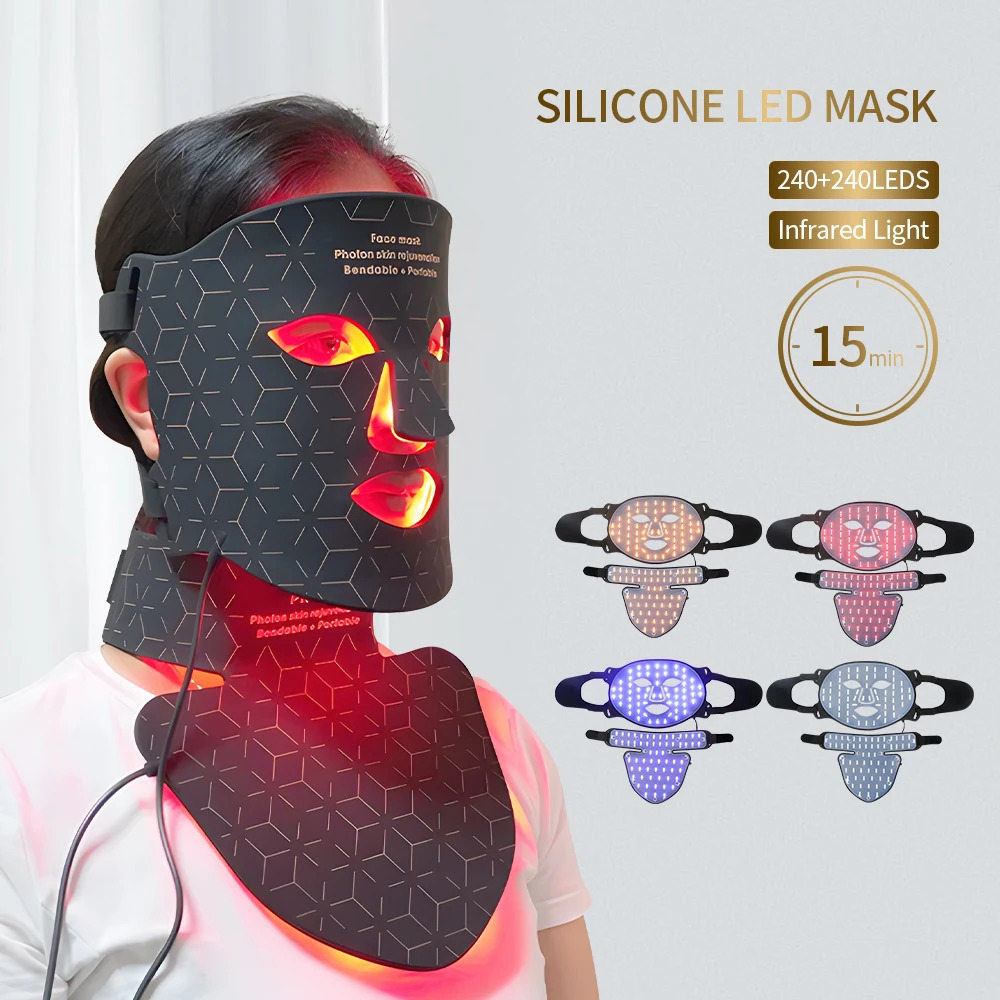
Flexible Soft Silicone LED Face and Neck Mask (Red & NIR Therapy Set)
This comprehensive dual-panel setup includes both a contoured facial mask and an independent neck/décolletage pad, making it a direct design equivalent to premium modular salon kits. The device incorporates 60 heavy-duty matrix LED units per panel (120 total emitter clusters), providing dense, uniform coverage without leaving cold treatment spots along the jawline or collarbone.
Equipped with an external 3000mAh rechargeable lithium battery control pack featuring a backlit digital readout, the system allows you to toggle visible light independently from the 850nm near-infrared diodes. It includes four intensity levels and customizable timers (10, 15, 20, or 30 minutes), giving you full control over your session dosage.
Verified Specifications
- Wavelengths: 630nm Red + 850nm Near-Infrared (plus optional visible blue and amber modes)
- Configuration: Two-piece flexible silicone system (Face + Neck/Chest)
- Emitter Count: 60 matrix LED modules per section (120 total)
- Battery & Controller: 3000mAh external power unit with digital LCD display
- Power Levels: 4 adjustable intensity stages
- Included: Face mask, neck panel, remote control battery, silicone eye cups, adjustable velcro straps, USB charging cable
Pros & Cons
- Pros: Independent NIR switch ensures true photobiomodulation; separate neck panel treats tech-neck and chest sun damage; heavy-duty silicone feels durable and cleans easily.
- Cons: Requires tethering to the external handheld battery unit; uses a proprietary barrel-to-USB charging connection on the battery end that must not be misplaced.
Original product URL — convert this manually to your Involve Asia deeplink:
https://www.aliexpress.com/item/1005005168963693.html
Lescolton Flexible Silicone LED Phototherapy Mask
Produced by established personal-care hardware manufacturer Lescolton, this featherweight (198g) silicone mask emphasizes ergonomic comfort and even beam diffusion. Featuring 240 targeted light points engineered across a bendable medical-grade silicone chassis, it hugs facial contours snugly without pressing painfully against the bridge of the nose or cheekbones.
The unit delivers three distinct therapeutic modes: combined Red (630nm) + Near-Infrared (850nm) for anti-aging collagen restoration, Blue (460nm) for clarifying surface bacteria, and Yellow/Amber (590–605nm) for flushing skin flushing and dullness. Each mode features three selectable output power levels and an integrated auto-shutoff timer for safe 10- to 30-minute treatments.
Verified Specifications
- Wavelengths: 630nm Red, 850nm NIR, 460nm Blue, ~590nm Yellow
- LED Matrix: 240 high-efficiency optical lines/emitters
- Weight: Approximately 198 grams (ultra-lightweight chassis)
- Material: Medical-grade bendable soft silicone
- Controller: Compact handheld wired remote with timer and intensity controls
Pros & Cons
- Pros: Exceptionally lightweight design eliminates tension headaches; well-established beauty electronics manufacturer; smooth interior surface is hypoallergenic and easy to wipe down.
- Cons: Covers the face only (no neck collar included); eye openings are slightly narrow for wider bone structures.
Original product URL — convert this manually to your Involve Asia deeplink:
https://www.aliexpress.com/item/3256806441512457.html

Hello Face L6 PDT High-Density Phototherapy Mask System
For buyers seeking higher optical bead density and multi-spectrum versatility, the Hello Face L6 PDT system delivers clinical-inspired phototherapy at a fraction of salon hardware prices. Packing 720 LED micro-chips into a multi-layer flexible architecture, this mask minimizes the gap between individual light nodes for exceptionally even energy distribution.
The L6 is built around four primary operating protocols: pure Blue (460nm) for inflammatory acne, Amber (605nm) for skin brightening, Red + NIR (630nm + 850nm) for full-face anti-wrinkle remodeling, and a Mixed Quad-Band mode. The package includes comprehensive silicone eye shield inserts and an intuitive digital smart controller that manages treatment timing down to the minute.
Verified Specifications
- Wavelengths: 460nm (Blue), 605nm (Amber), 630nm (Red), 850nm (Near-Infrared)
- Chip Density: 720 high-output LED chips
- Treatment Modes: 4 distinct clinical protocols (Acne, Brightening, Wrinkles, Mixed)
- Certifications: CE and RoHS compliant manufacturing specifications
- Included: Flexible high-density mask, ergonomic harness, digital controller, silicone eye cups, USB-C power lead
Pros & Cons
- Pros: Massive 720-chip density provides superior photon saturation; dedicated Amber 605nm wavelength targets skin barrier recovery; detailed English operational manual with clear contraindication guidelines.
- Cons: Higher chip count makes the unit run slightly warmer during 20-minute sessions; controller is slightly bulkier than minimalist remotes.
Original product URL — convert this manually to your Involve Asia deeplink:
https://www.aliexpress.com/item/1005007037528412.html

Ultra-Budget Flexible Red & NIR Silicone Therapy Mask
Frequently highlighted in enthusiast communities (such as Reddit's r/redlighttherapy and deal forums like OzBargain) as the quintessential entry-level alternative to $500 branded masks, this direct-from-factory model strips out excessive marketing fluff to deliver core photobiomodulation basics at approximately $40 to $50. Built from soft food-grade silicone, it features an integrated red and near-infrared diode grid designed specifically to target forehead lines, crow's feet, and perioral folds.
While minimalist in packaging, the device features USB rechargeable operation, multiple light spectrum selections, and adjustable elastic fastening straps that hold the diodes snug against the skin. For shoppers who want to test the consistency of a daily phototherapy routine before investing in high-ticket systems, this offers an unbeatable price-to-performance threshold.
Verified Specifications
- Wavelengths: 630nm Red + 850nm Near-Infrared dual-spectrum delivery
- Design: One-piece contoured soft silicone mask
- Power Supply: USB rechargeable internal battery with inline push-button control
- Fit: Dual adjustable elastic strap harness
Pros & Cons
- Pros: Extremely low barrier to entry; identical basic silicone form factor to high-priced retail masks; lightweight and travel-friendly.
- Cons: Basic packaging without a luxury travel case; smaller battery capacity requires more frequent recharging (every 3–4 sessions).
Original product URL — convert this manually to your Involve Asia deeplink:
https://www.aliexpress.com/item/1005008257879065.html
How to Shop AliExpress for Phototherapy Without Getting Scammed
While the savings are substantial, shopping direct-from-factory requires diligence. Here is the exact checklist Lastatek editors use to screen phototherapy devices:
1. How to Test for Real Near-Infrared (850nm) Light
Because the human eye cannot perceive light beyond approximately 700nm, genuine near-infrared (830–850nm) diodes will look completely unlit or emit only a very faint, dull purple-red glow when active. If a seller's "infrared" mode shines bright visible red or pink light without invisible diode nodes, the manufacturer has simply wired standard red LEDs to the circuit. You can verify invisible NIR emission at home using an older smartphone camera or a digital remote-control tester, as phone camera sensors lack complete infrared cutoff filters and will display NIR diodes as pale violet spots.
2. Inquire About Chip Packaging (Single-Die vs. Multi-Die)
Top-tier models utilize dual-chip or multi-die SMD LEDs, meaning a single transparent silicone bead contains both a 630nm red emitter and an 850nm near-infrared emitter. Lower-cost units alternate single diodes (e.g., one red bead, one NIR bead). Alternating layouts are acceptable, but dual-chip designs deliver more balanced, uniform photonic distribution across every square centimeter of skin.
3. Review Electrical Certification and Power Delivery
Ensure the manufacturer lists basic CE, RoHS, or FCC quality testing. Avoid plugging battery controller units directly into high-wattage fast-charging phone bricks (like 65W or 100W laptop chargers); flexible silicone masks are designed for standard 5V/1A or 5V/2A power supplies to preserve the lifespan of the built-in lithium-ion cells.
Best Practices for At-Home Treatment Protocols
- Cleanse First: Always wash your face thoroughly to remove mineral sunscreens, thick oils, and heavy moisturizers. Titanium dioxide, zinc oxide, and dense lipids reflect and scatter red and NIR light, drastically reducing tissue penetration.
- Keep Skin Bare or Use Water-Based Serums: For optimal absorption, use the mask on clean, dry skin. If you prefer a slip, apply a pure hyaluronic acid or glycerin-based hydrating serum. Avoid retinol, AHA/BHA exfoliating acids, and benzoyl peroxide immediately before LED exposure to prevent photosensitive irritation.
- Follow the 10-to-20 Minute Rule: Photobiomodulation follows a biphasic dose-response curve (the Arndt-Schulz law). More is not always better. Operating a mask for 10 to 15 minutes 3 to 5 times per week stimulates optimal cellular repair; exceeding 30 minutes in a single sitting can cause cellular fatigue and diminish clinical benefits.
- Sanitize Regularly: Clean the silicone face surface after every treatment using a 70% isopropyl alcohol wipe or an antibacterial wipe. Allow it to air dry fully before storing it flat in a protective pouch. Never fold the silicone sharply, as this can sever the internal printed electrical circuitry.
Frequently Asked Questions
Are $50 to $90 AliExpress masks as effective as $400 branded masks?
In terms of optical physics, yes—provided the factory-direct mask emits accurate 630nm red and 830nm/850nm NIR wavelengths at 15–35 mW/cm². The core components (medical silicone and SMD LED diodes) are virtually identical across both tiers. The $300+ price gap primarily covers Western marketing budgets, influencer campaigns, domestic warranty overhead, and FDA 510(k) clearance paperwork.
Can red light therapy cause facial fat loss?
No scientific evidence indicates that low-level home photobiomodulation masks cause subcutaneous fat atrophy. High-energy targeted laser adipolysis requires specialized thermal lasers operating at distinct wattages and wavelengths (such as 1060nm) specifically designed to generate hyperthermic cell disruption. At-home silicone LED masks emit non-thermal, low-intensity light that supports cellular metabolism without heating or damaging fat pads.
Can I use an LED mask if I have melasma or hyperpigmentation?
Pure red (630nm) and near-infrared (850nm) light are widely used to reduce inflammation and calm skin. However, individuals prone to heat-induced melasma flare-ups should monitor their skin response closely. Choose a flexible silicone mask with low thermal output, avoid running high-intensity sessions beyond 10 minutes, and refrain from using yellow or blue modes if your pigmentation reacts to visible light.
The Bottom Line
You do not need to spend half a thousand dollars to reap the skin-rejuvenating benefits of photobiomodulation. By choosing a verified factory-direct silicone mask—such as the Flexible Face and Neck Dual-Panel Set or the ultra-lightweight Lescolton LED Mask—you get the exact same therapeutic wavelengths and close-contact ergonomics for a fraction of the cost. Inspect the bead quality, protect your eyes, stick to a consistent 15-minute routine, and let the photobiology do the work.
اترك رأيك بتعليق